Aug 27, 2026
Product Logo or Branded Packaging? A Decision Guide for Corporate Gift Buyers
A practical framework for deciding whether your logo belongs on the promotional product, its packaging, or both—based on visibility, reuse, budget, lead time and recipient experience.
Product Logo or Branded Packaging? A Decision Guide for Corporate Gift Buyers
A logo can be printed on the product, placed on the packaging, or used on both. Those options may look similar on a quotation, but they create very different recipient experiences.
The right choice depends on what should remain visible after the gift is opened, how the item will be used, the available decoration area, and whether packaging is part of the presentation. The following framework helps buyers make that decision before approving artwork and samples.
- Start with the job the branding must do
Product branding is designed for repeated exposure. A logo on a bottle, notebook, charging cable or tote bag can stay visible each time the recipient uses the item.
Packaging branding is strongest at the moment of delivery. A printed sleeve, belly band, sticker, card or gift box can explain why the gift was sent and connect several products to one campaign.
Ask one question first: should the brand be remembered during everyday use, or should it create impact when the gift is opened?
If repeated visibility matters, prioritize the product. If presentation and storytelling matter, prioritize the packaging. If both moments matter, divide the message between them instead of printing the same large logo everywhere.
- Put the logo on the product when reuse is the main value
Product decoration usually makes sense when the item will be used frequently and has a clean, durable print area.
Good candidates include drinkware, bags, notebooks, desk accessories, umbrellas and selected technology items. A small, well-positioned logo often feels more premium than a large mark that dominates the product.
Before approval, check:
• the actual printable area in millimeters;
• whether the surface is flat, curved, textured or flexible;
• the likely decoration method;
• color contrast between the logo and product;
• whether the logo remains visible during normal use;
• whether fine lines or small text will reproduce clearly.
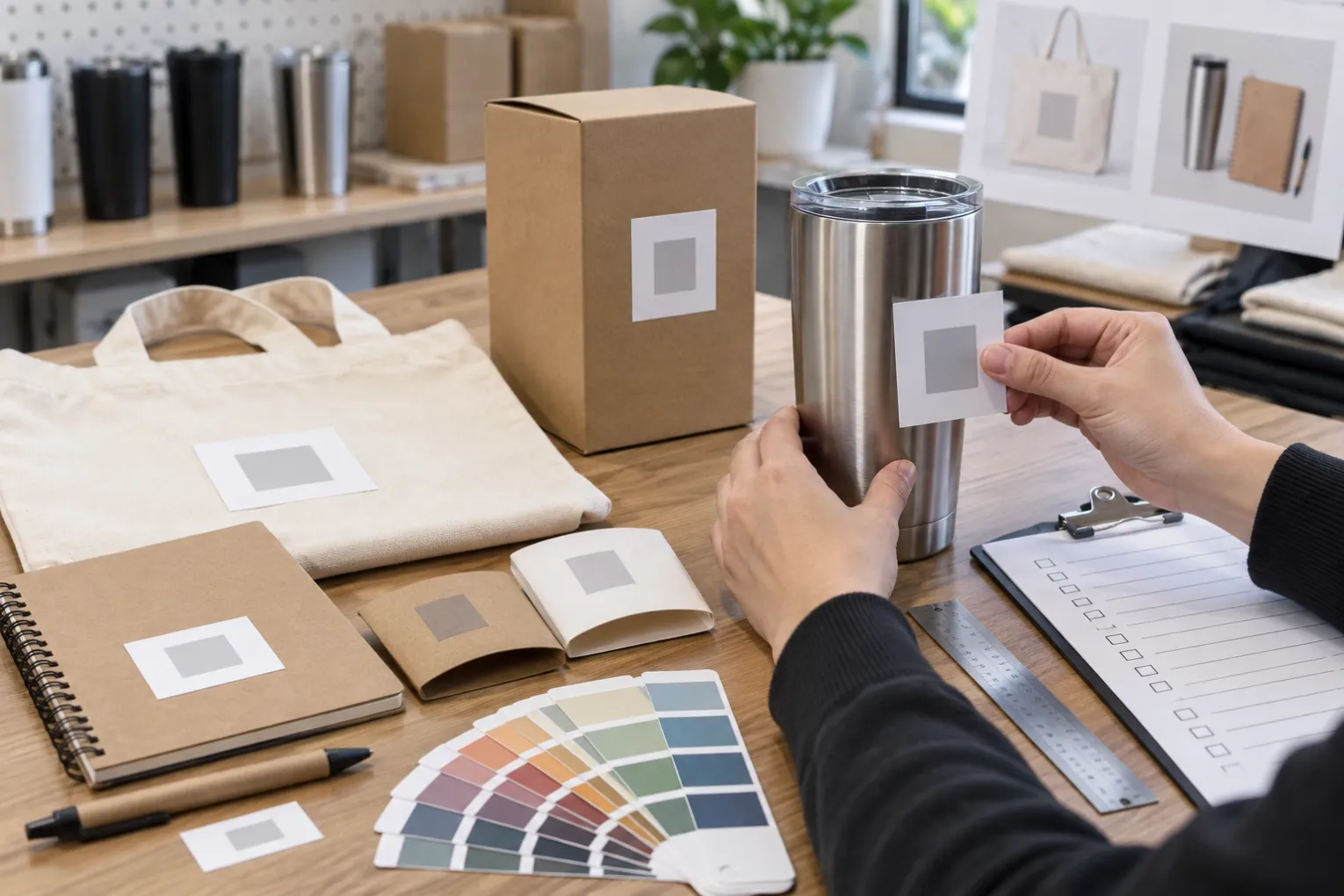
A logo may look large on a digital proof but appear much smaller on the real product. Buyers should request a scale reference or physical sample whenever placement is important.
- Use branded packaging when the product should feel retail-ready
Packaging is often the better branding surface when the product itself is small, highly textured, difficult to print or intended to look like a tasteful retail item.
For example, a cable organizer, compact repair kit or earplug case may have limited decoration space. A printed card, sleeve or box can provide room for a campaign message, usage instructions, QR code and recipient name without overcrowding the product.
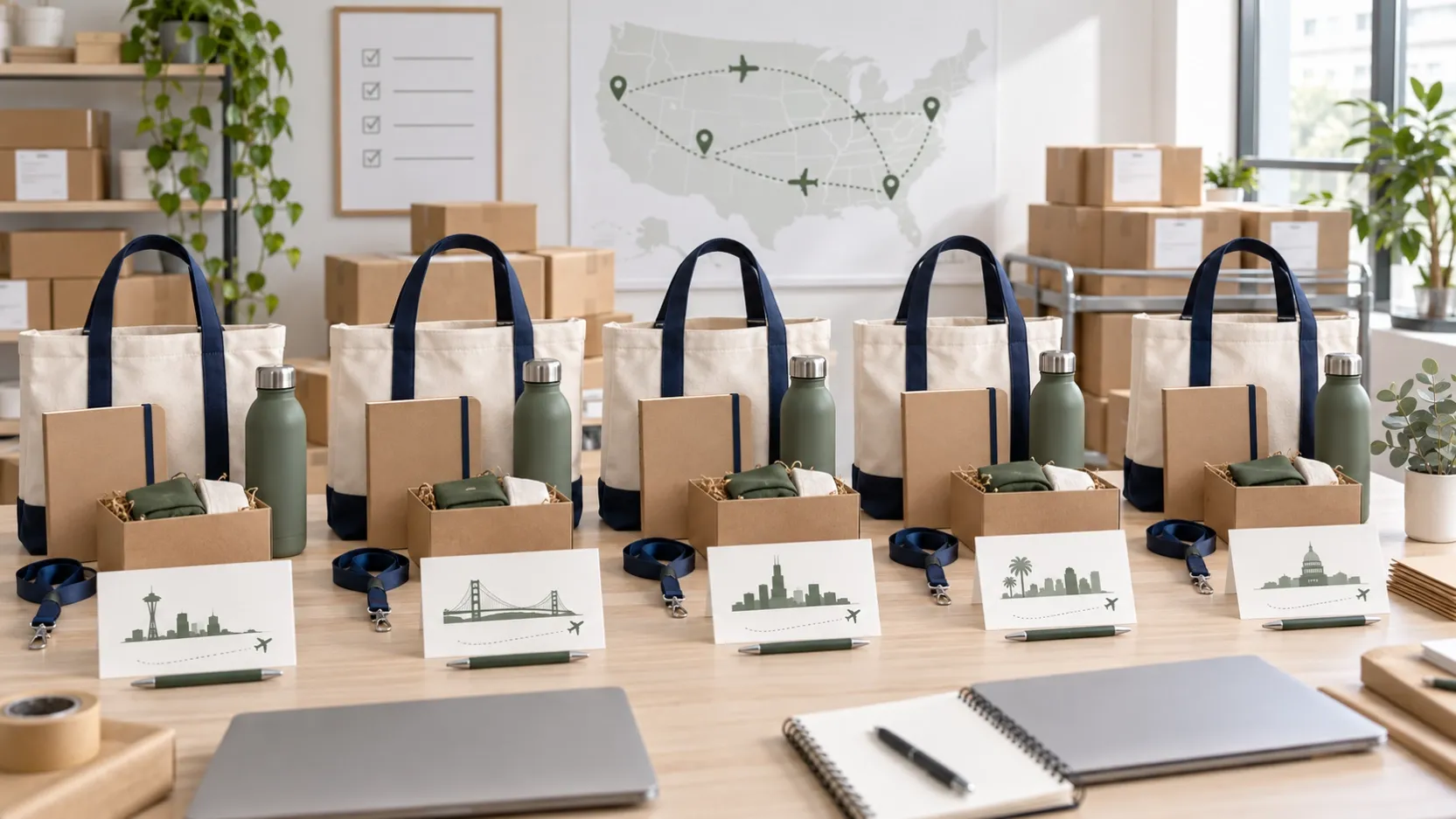
Packaging can also unite mixed products. In a welcome kit, the bottle, notebook and cable may use different materials and decoration processes. One consistent outer box or insert creates a stronger visual system.
This approach works particularly well for:
• customer thank-you gifts;
• employee onboarding kits;
• product launches;
• event speaker gifts;
• direct-mail campaigns;
• partner and distributor programs.
- Choose both when the two branding moments are different
Using both product and packaging does not mean duplicating the same artwork.
A better system is:
• Product: small logo or subtle brand mark.
• Packaging: campaign headline, occasion, recipient message or QR code.
• Insert card: practical information, sustainability details or call to action.
This creates a clear hierarchy. The packaging explains the gift; the product continues to carry the brand after the packaging is removed.
For premium gifts, this separation often feels more considered. The item remains usable in daily life, while the packaging provides the stronger launch or presentation moment.
- Match the method to the material
Decoration quality depends on the surface.
Laser engraving works well on many metal, bamboo and coated surfaces and provides a durable, understated finish. Screen or pad printing can be efficient for simple logos and small promotional runs. Full-color UV or digital printing is useful when gradients, multiple colors or variable artwork are required. Embroidery suits textile products but needs thicker lines and simplified details.
Packaging provides additional options such as printed sleeves, labels, tissue seals, cards and box printing. For small orders, a standard stock box plus a printed sleeve or sticker may be more practical than fully custom packaging.
Always confirm the method after selecting the actual product. Artwork should not be finalized around a decoration process that the chosen material cannot support.
- Compare the hidden cost, not only the unit price
The lowest decoration price is not always the lowest project cost.
Product printing may require setup charges, individual handling, color matching and additional sample approval. Fully custom packaging may require cutting tools, higher minimums, longer production time and larger shipping volume.
A useful quotation should separate:
• product cost;
• decoration setup and unit cost;
• packaging material and printing;
• assembly or kitting;
• sample cost;
• carton size and freight impact;
• expected production time.
For a low-quantity campaign, a stock product with a simple one-color logo and a customized card or sleeve can often deliver a stronger result than an elaborate custom box.
- Approve the complete branded experience
Do not approve the product proof and packaging proof in isolation. Review them together at realistic scale.
Check whether the logo position is visible, whether the packaging message repeats information unnecessarily, whether the colors are consistent, and whether the recipient immediately understands the purpose of the gift.
If possible, request one assembled sample showing the product inside the packaging. This reveals problems that separate digital proofs may miss, including loose fit, hidden artwork, abrasion and an insert card that covers the product.
A simple decision rule
Choose product branding when daily visibility and long-term use matter most.
Choose packaging branding when presentation, explanation or campaign storytelling matters most.
Choose both when the package should introduce the message and the product should carry a quieter reminder afterward.
The best branded gift is not the one with the largest logo. It is the one where branding, product utility and presentation support the same objective.
Related guides
Why Logos Look Too Small on Corporate Gifts: Print-Area Rules for Bottles, Bags and Gift Boxes
https://www.suoyigroup.com/posts/logo-print-area-rules-corporate-gifts-packaging
How to Keep Event Giveaway Packaging Simple
https://www.suoyigroup.com/posts/event-giveaway-packaging-guide
From Inquiry to Approved Sample: A 7-Step Corporate Gift Sourcing Workflow
https://www.suoyigroup.com/posts/corporate-gift-sourcing-workflow-inquiry-to-approved-sample