Aug 11, 2026Buying Guides
How to Choose Custom Lanyards for Trade Shows and Employee Programs
A practical guide to choosing custom lanyards for trade shows and employee programs, covering materials, logo methods, hardware, badges, safety, and ordering details.
How to Choose Custom Lanyards for Trade Shows and Employee Programs
Choose a custom lanyard by starting with what it must carry, where it will be worn, and how long it will be used. A trade-show badge, employee access card, key, phone pouch, and event credential place different demands on the strap and hardware. Once the function is clear, you can compare material, width, logo method, attachment, safety features, artwork, packing, and delivery requirements.
This guide gives event organizers, promotional product distributors, marketing agencies, importers, and corporate buyers a practical framework for preparing a lanyard inquiry.
Start with the lanyard’s job
The first question is not “Which color looks best?” It is “What does the lanyard need to do?” Define the application before reviewing styles.
Trade shows and conferences
Attendees may wear the lanyard for an entire day while moving between registration, meetings, and exhibition areas. Badge visibility, comfort, attachment compatibility, and delivery timing are usually more important than adding complex accessories.
Employee identification
Employee lanyards may be used repeatedly with an ID or access card. Durability, card accessibility, safety requirements, replacement planning, and consistency across repeat orders deserve extra attention.
Visitor and contractor programs
Different strap or badge colors can help distinguish visitors, contractors, staff, speakers, or access levels. The classification system should be easy to recognize without making the printed artwork overcrowded.
Promotional campaigns
For a giveaway, the lanyard may carry keys, a card wallet, or a small accessory. Confirm the expected use instead of selecting hardware that adds cost but offers no practical benefit.
Choose a material that suits the artwork and wearing time
“Polyester lanyard” can describe several constructions and finishes. Ask for a physical sample or clear specification when hand feel, appearance, or long-term use matters.
Flat polyester
Flat polyester is widely used for events and identification programs. It provides a familiar woven surface and can support straightforward printed branding. The exact texture, thickness, and print result vary by construction.
Consider it when:
- The project needs a practical general-purpose strap
- The logo uses solid colors and uncomplicated details
- The lanyard will carry a badge or lightweight card holder
- Budget and repeatability are important
Smooth polyester for sublimation
A smoother strap can suit dye-sublimated graphics, gradients, repeated patterns, or designs requiring color across a larger area. Artwork still needs to account for edges, stitching, hardware, and possible alignment differences.
Consider it when:
- The design contains multiple colors or gradients
- Sponsor logos need more detail
- Edge-to-edge visual coverage is requested
- The event identity depends on a specific pattern
Woven or jacquard styles
Woven branding integrates the design into the strap instead of printing it onto the surface. It can create a durable, understated appearance, but very small text and detailed graphics may need simplification.
Consider it when:
- The lanyard is intended for repeated use
- The artwork is simple enough to reproduce in woven form
- A textile appearance supports the brand
- Fine photographic detail is not required
Tubular and other constructions
Tubular lanyards have a rounded construction and may feel different from flat straps. Other options may use recycled-content fibers or alternative materials. Material claims should be supported by product-specific documentation rather than a generic label.
Select the width by function and artwork
Width affects comfort, logo visibility, weight, and cost. A narrow strap may suit a simple repeating mark, while a wider strap provides more room for text or sponsor branding. However, a wide lanyard is not automatically better.
When reviewing width, ask:
- How many logos or words must appear in one repeat?
- Will the logo remain readable at the proposed print size?
- How heavy is the badge or attached item?
- Will attendees wear it over a shirt, jacket, or uniform?
- Does the hardware visually match the strap width?
Request an artwork proof at actual size. A design that looks clear when enlarged on a screen may become unreadable on the finished strap.
Match the attachment to the badge or item
The attachment is a functional specification, not a decorative afterthought. Ask for the badge, card holder, or item dimensions before selecting it.
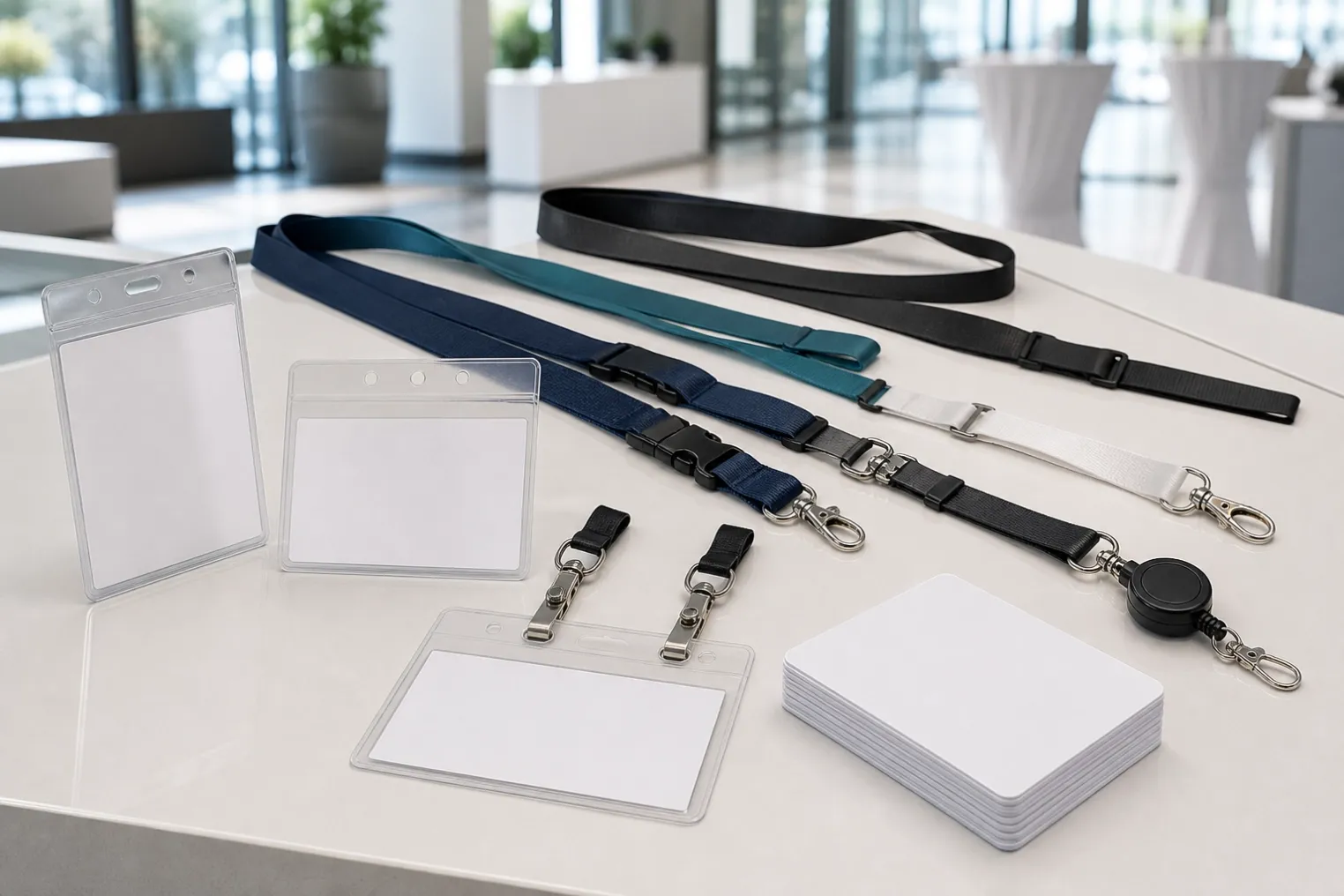
Swivel hook or trigger-style clip
These clips can connect to many punched badges and holders. Confirm the slot or hole dimensions and whether the badge orientation remains stable.
J-hook or simple metal hook
A simple hook may suit lightweight event badges. Review the opening, wire thickness, and compatibility with the selected holder.
Split ring
Split rings can work for keys or accessories but may be less convenient when cards need to be removed frequently.
Badge reel
A retractable reel helps users present an access card without removing the lanyard. Confirm reel length, retraction strength, card-holder connection, and expected frequency of use.
Detachable buckle
A detachable buckle lets the wearer remove the lower attachment while keeping the strap in place. This can be useful for keys or access cards, but it adds another component that must be checked during inspection.
Dual attachments
Two clips can help stabilize a wide badge and reduce rotation. The badge needs two correctly positioned slots, and the spacing must match the finished setup.
Always test the complete assembly—not only the strap and clip separately.
Decide whether a safety breakaway is required
A breakaway component is designed to release when force is applied. It may be appropriate in certain workplaces, schools, healthcare settings, production areas, or events, but requirements differ by organization and environment.
Do not market any lanyard as “safe for every workplace.” Instead:
- Ask the buyer whether a breakaway feature is mandatory
- Confirm the number and location of breakaway points
- Review applicable workplace policies and local requirements
- Keep lanyards away from machinery or other hazards unless the responsible safety team approves their use
- Obtain and test the exact configuration required for the program
A breakaway is one component of a safety decision; it does not replace a workplace risk assessment.
Plan the badge and lanyard together
Many lanyard problems originate with the badge rather than the strap. Badge size, weight, slot location, holder material, orientation, and on-site printing process can all affect performance.
Before ordering, confirm:
- Finished badge dimensions
- Portrait or landscape orientation
- One slot, two slots, or a separate holder
- Badge and holder weight
- Whether variable names or QR codes will be printed on site
- Whether the holder needs to be reusable, weather-resistant, or sealed
- Whether cards must be scanned without removal
Create one assembled sample with the real badge. Wear it, walk with it, scan it, and confirm that it faces forward and remains comfortable.
Prepare artwork for a narrow repeating space
A lanyard is not a miniature banner. Long company names, multiple sponsor logos, event dates, URLs, and slogans can become difficult to read when placed together.
For clearer artwork:
- Prioritize the main logo or event name
- Use a repeat that works around clips and buckles
- Keep important elements away from seams and hardware
- Simplify fine lines and very small text
- Provide vector files when available
- Include brand color references
- Confirm whether artwork prints on one side or both sides
- Ask how the reverse side and strap edges will appear
If many sponsors require visibility, consider placing the full sponsor group on the badge while keeping the lanyard design simpler.
Use color to support event operations
Color can help staff distinguish attendee groups, but it needs a controlled system. Too many similar shades may be hard to recognize under venue lighting.
A program might assign different colors to:
- Attendees
- Exhibitors
- Speakers
- Staff and volunteers
- VIP guests
- Contractors or temporary visitors
Record every color assignment in the order specification and packing instructions. If multiple versions are packed together, require clear carton and inner-pack labels to reduce registration errors.
Check comfort and usability before bulk production
Comfort depends on more than material softness. Strap width, edge feel, hardware weight, seams, neck length, badge weight, and wearing time all contribute.
Use a sample to check:
- Whether the strap lies flat
- Whether printed areas feel acceptable against clothing or skin
- Whether the badge hangs at a practical height
- Whether hardware twists the badge
- Whether the buckle and breakaway position are comfortable
- Whether the assembled lanyard is easy to put on and remove
For employee programs, ask several users to test the sample instead of relying on one reviewer.
Build the schedule backward from the event date
The required date should mean arrival at the event location—not merely completion at the factory. A custom project may require time for artwork review, proof approval, sampling, production, inspection, packing, shipping, customs clearance, and local delivery.
Include schedule time for:
- Finalizing the badge and attachment
- Supplying usable artwork
- Reviewing a digital proof
- Approving a sample when required
- Producing each color or attendee version
- Inspecting hardware and print
- Packing by role, team, or registration group
- Shipping to the final destination
Allow a practical buffer where possible. If the schedule is tight, ask which standard materials, colors, or attachments are available for the requested quantity instead of assuming every configuration has the same lead time.
Compare quotations using the same specification
A low unit price may exclude components included elsewhere. Check that every supplier is quoting the same scope:
- Material, width, length, and construction
- Logo method, sides, colors, and repeat
- Attachment and finish
- Breakaway and detachable components
- Badge holder or printed badge
- Artwork, setup, or tooling charges
- Individual packaging and sorting
- Inspection requirements
- Carton quantities and dimensions
- Shipping terms and destination
Ask suppliers to identify substitutions clearly. Even a small hardware change can affect the complete badge setup.
Information to send with a custom lanyard inquiry
Provide:
- Application: trade show, conference, workplace, visitor program, or giveaway
- Estimated quantity and any color split
- Required arrival date
- Delivery country, postal code, or port
- Preferred material, width, and color
- Logo file and brand color references
- Printing or woven preference, if known
- Badge or item dimensions, weight, and slot configuration
- Required attachment, buckle, reel, or breakaway feature
- Packing, labeling, testing, and documentation requirements
If you are unsure about the hardware, send a photo or specification of the badge and explain how users will access it.
Frequently asked questions
Which lanyard material is best for a trade show?
There is no single best material. Flat polyester can suit many straightforward programs, smooth sublimation material can support detailed multicolor artwork, and woven styles can suit simpler branding and repeated use. Choose according to artwork, comfort, application, and budget.
Do event lanyards need a breakaway?
It depends on the venue, audience, workplace policy, and risk assessment. Ask the responsible event or safety team before specifying the product.
How can I stop conference badges from flipping?
A two-point attachment may help stabilize a compatible badge. Badge weight, slot position, holder construction, hardware, and strap twist also affect orientation, so test the complete assembly.
Can different attendee groups use different colors?
Yes, subject to availability and order requirements. Provide a clear quantity breakdown and require labeled packing so registration staff can identify each version quickly.
What artwork format should I send?
Vector files such as AI, EPS, or editable PDF are commonly preferred, but requirements depend on the logo method. Send the best available artwork and ask the supplier to confirm suitability.
Specify the complete credential system
The best custom lanyard is the one that works with the badge, wearer, venue, and operating plan. Define the function first, test the complete assembly, simplify the artwork, and compare quotations using the same specification.
Explore Suoyi Promotional Gifts’ custom promotional product options or send your lanyard project requirements. Include the use case, quantity, artwork, badge details, attachment, destination, and required date so our team can review suitable options.